
Rådhusplassen
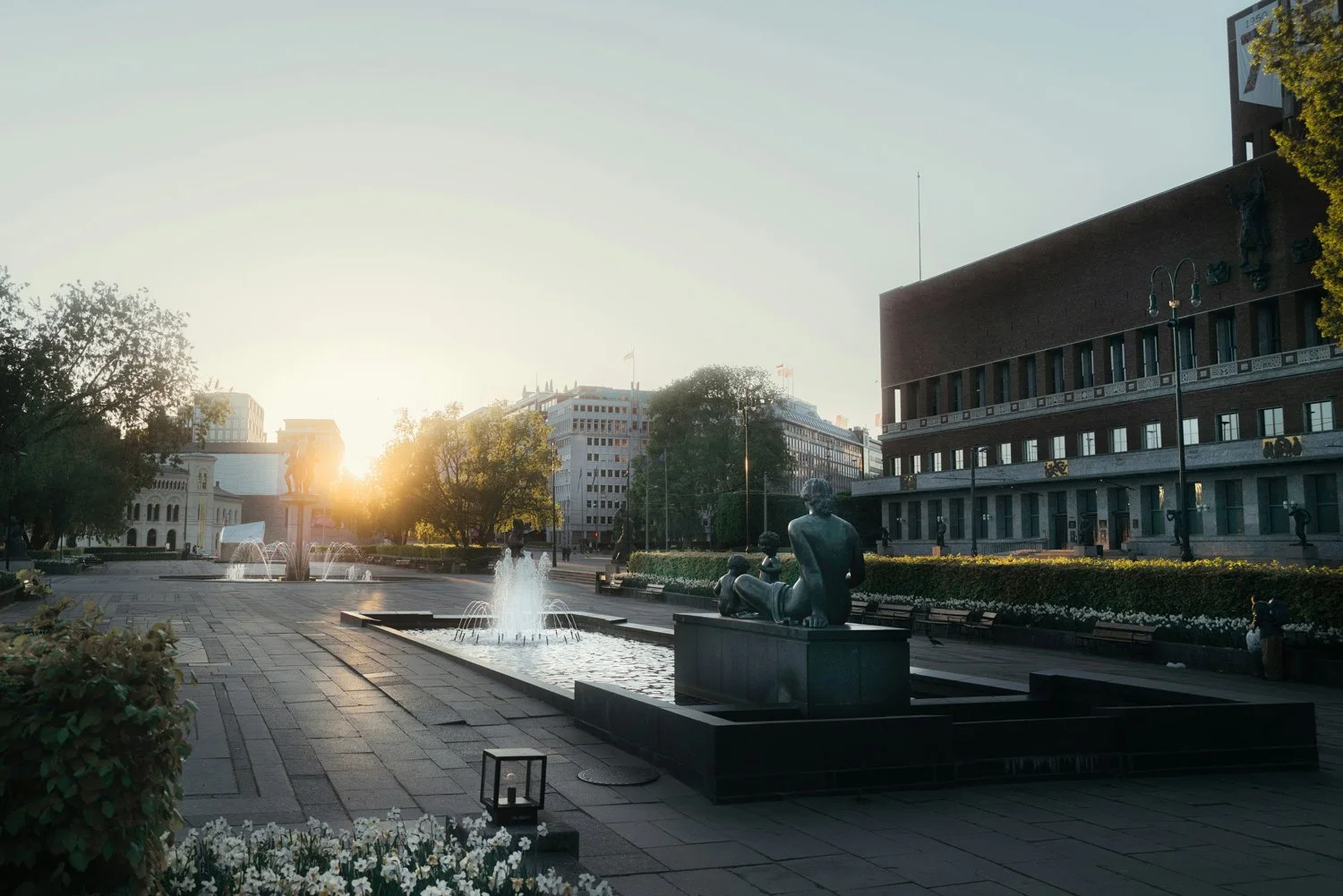
Rådhusplassen bathed in the soft evening light of May.
The Grand Civic Stage Where Oslo Meets the Fjord
Discover Rådhusplassen in Oslo, the monumental waterfront square between Oslo City Hall and the Oslofjord. Explore its history, architecture, ferries, events, Nobel Peace Prize connections, nearby museums, walking routes, photography spots, and practical visitor tips.
Oslo’s Most Symbolic Open Space
Rådhusplassen is not merely a square. It is one of Oslo’s great urban thresholds: a broad, ceremonial expanse where the city’s political heart opens directly toward the Oslofjord. Behind you rise the twin red-brick towers of Oslo City Hall; ahead, the water, ferries, piers and islands of the fjord. To one side are the restaurants and promenades of Aker Brygge; to the other, the medieval presence of Akershus Fortress. Few places in Oslo express the city’s identity so clearly: democratic, maritime, cultural, and increasingly pedestrian-friendly. The City of Oslo describes Rådhusplassen as the “heart of Fjordbyen” and one of Oslo’s finest outdoor spaces, with major historic importance.
For visitors, Rådhusplassen is both a landmark and a launchpad. It is where you begin a fjord cruise, cross into the Nobel Peace Prize landscape, photograph one of Norway’s most recognisable civic buildings, or pause between museums, trams and waterfront dining. It is also a place locals know intimately: a venue for festivals, concerts, civic gatherings, summer cafés, public celebrations and quiet winter crossings. Since 1994 the square has been car-free, and the transformation from traffic corridor to public space remains one of modern Oslo’s most meaningful urban changes.
The Setting: Between City Hall and the Oslofjord
Rådhusplassen sits at the edge of Oslo’s central harbour, in the Vika/Pipervika waterfront area, directly in front of Oslo City Hall. The square opens southward toward Rådhusbryggene, the City Hall piers, and the inner Oslofjord. This location gives the place its special character: it is neither only a civic plaza nor only a waterfront promenade, but a fusion of both. Oslo’s Harbour Promenade passes this area, linking older districts, new waterfront architecture, cultural institutions, food destinations and public seating along an almost 10-kilometre seafront route.
The surroundings make Rådhusplassen unusually rich for a single urban space. Oslo City Hall frames the northern side; the Nobel Peace Center stands nearby at City Hall Square; the National Museum is a short walk west; Akershus Fortress is to the east; and Aker Brygge and Tjuvholmen continue the waterfront westward with restaurants, shops, galleries and fjord views.
A Square Reclaimed from Traffic
One of the most important chapters in Rådhusplassen’s story is its transformation from a traffic-dominated area into a civic and recreational space. Until the late twentieth century, the square was associated with heavy road infrastructure, including the old E18 traffic route through the waterfront. In 1994, Rådhusplassen became car-free. In 1995, a new tram line across the square was established, while remaining motorway elements were removed as part of the Festningstunnelen and Vestbanekrysset developments.
That change did more than improve the look of the square. It altered the psychological geography of Oslo. The City Hall was no longer separated from the fjord by traffic; the people of Oslo could once again move naturally between the city’s political centre and its maritime edge. In a city where fjord access has become a defining urban ambition, Rådhusplassen is one of the clearest examples of Oslo’s move from industrial and car-based waterfronts toward open, walkable public life. VisitOSLO similarly describes the harbour promenade as the result of a shift from shipyards, containers and heavy traffic to pedestrian walkways, parks, benches and cultural experiences along the water.
Oslo City Hall: The Monumental Backdrop
The square’s architectural anchor is Oslo City Hall, inaugurated in 1950 and today the seat of Oslo’s city council and administration. The building is open to visitors and is famous for its monumental art, civic symbolism and distinctive red-brick towers. Oslo Municipality notes that the City Hall tower contains the largest carillon in the Nordic countries, and that the bells play every hour from 7 a.m. to midnight.
The building is more powerful in person than in photographs. Its brick façade can appear austere at first, but the details reveal themselves slowly: sculptural reliefs, ornamental elements, clock faces, fountains, gateways and murals. Inside, the City Hall is one of Oslo’s great artistic interiors, decorated with Norwegian art connected to national history, culture and working life. Visit Norway describes the building as the city’s administrative body and the seat of the City Council, decorated by major Norwegian art from the period 1900–1950.
For a visitor standing in Rådhusplassen, the City Hall gives the square its sense of ceremony. The broad façade, the towers and the open plaza create a civic stage: a place made for gatherings, processions, speeches, concerts and public life. Even on an ordinary weekday, the scale of the building makes the square feel important.
The Nobel Peace Prize Connection
Rådhusplassen also belongs to Oslo’s identity as a city of peace. Every year on 10 December, the Nobel Peace Prize is awarded in a formal ceremony inside Oslo City Hall, where the laureate receives the Nobel medal and diploma and delivers the Nobel lecture.
Across the square, the Nobel Peace Center deepens that connection. The centre describes itself as the museum of the Nobel Peace Prize, located at City Hall Square in the middle of Oslo. It presents exhibitions, events and guided tours inspired by the ideas and work of Nobel Peace Prize laureates.
This gives Rådhusplassen a symbolic layer that is rare for a public square. It is not just a scenic meeting place; it is part of a global ritual of recognition, diplomacy, human rights and moral leadership. In December, the atmosphere around the square changes: security, media attention, ceremonies and public events remind visitors that Oslo’s waterfront is also an international stage.
Rådhusbryggene: The Piers Below the Square
At the fjord side of Rådhusplassen lie Rådhusbryggene, the City Hall piers. Oslo Havn describes four jetties in front of Oslo City Hall and Rådhusplassen, collectively known as Rådhusbryggene. From this area, visitors can access public ferries, charter boats, antique and classic vessels, commercial fishing boats and other maritime activity.
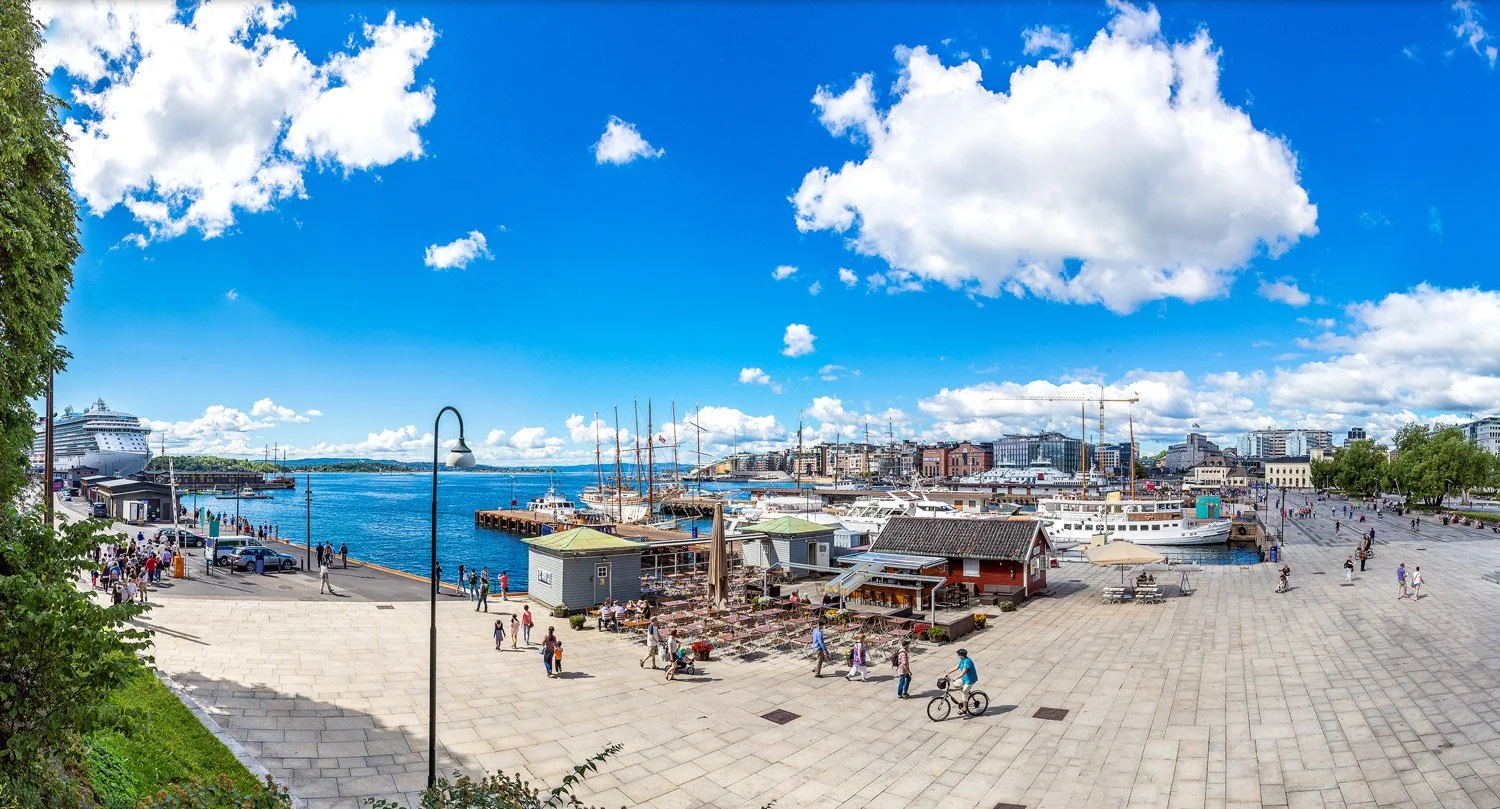
Rådhusbryggene: The Piers Below the Square
This is one of the best things about Rådhusplassen: within minutes, you can move from a monumental civic square to a boat bound for the islands. Visit Norway notes that ferries from Rådhusbrygge 4 take passengers to islands in the inner Oslofjord, while the Bygdøy ferry operates from Rådhusbrygge 3 and connects the City Hall area with the museum peninsula.
In summer, this maritime layer is especially vivid. People gather along the quays, ferries come and go, tour boats advertise fjord cruises, and the square becomes part waiting room, part promenade, part outdoor salon. In winter, the mood is quieter and more atmospheric, with the open water, low light and City Hall towers creating one of Oslo’s most cinematic urban scenes.
Events, Festivals and Public Life
Rådhusplassen is one of Oslo’s major outdoor event spaces. According to the City of Oslo, the summer half of the year brings festivals, concerts and other open-air events to the square, while tourist and cruise boats depart from the City Hall piers during the same season.
The municipality also allows applications to rent all or parts of Rådhusplassen for events, with guidelines emphasising that events should respect the square’s representative character, have public content, be free for the public, avoid unnecessary physical barriers, limit commercial activity and avoid dominant sponsor profiling. July is listed as an event-free period.
This tells you something important about the place: Rådhusplassen is not designed only as scenery. It is a civic room, and the city treats it as such. It can host crowds, public ceremonies and cultural programmes, but it is also expected to remain open, democratic and dignified.
What to See at Rådhusplassen
1. The City Hall Façade
Begin by standing in the middle of the square and looking north. The City Hall’s towers, brickwork and clock faces are the defining view. Morning light is often soft and architectural; evening light can turn the façade warm and dramatic.
2. The City Hall Courtyard and Interior
When open, the City Hall is worth visiting, not only for its political function but for its murals, ceremonial halls and artistic programme. Oslo Municipality lists the City Hall at Rådhusplassen 1 and states that normal visitor opening hours are daily from 09:00 to 16:00, though exceptions and room closures can occur. All visitors must pass through security.
3. The Carillon
Listen for the bells. Oslo Municipality says the City Hall bells play every hour from 7 a.m. to midnight, with music ranging from classical pieces to more recent pop.
4. Rådhusbryggene and the Fjord
Walk down toward the piers. This is where the square becomes maritime. You can watch ferries depart, join a sightseeing cruise, photograph boats against the City Hall, or continue along the Harbour Promenade.
5. Nobel Peace Center
Just across the square, the Nobel Peace Center offers exhibitions and guided experiences about the Nobel Peace Prize and its laureates. Its location at City Hall Square makes it a natural companion to a visit to Rådhusplassen and Oslo City Hall.
6. Harbour Promenade Wayfinding
Look for the orange information towers along the Harbour Promenade. Placed at regular intervals, the towers serve as informative landmarks, offering insights into nearby points of interest and the rich history of the area.
7. The Sculptures and Fountains of Rådhusplassen: Oslo’s Open-Air Civic Gallery
Rådhusplassen is often admired for its grand scale, its fjord views and the monumental façade of Oslo City Hall. Yet one of its most rewarding layers is more intimate: the collection of sculptures, fountains and symbolic figures that turn the square into an open-air civic gallery. These works are not decorative afterthoughts. They are part of the square’s identity, linking Oslo’s maritime history, working-class heritage, mythic imagination, civic pride and human warmth.
At the heart of the square lies the sunken sculpture and fountain area often known as “Synken” — literally “the sink” or “the sunken space.” This lowered composition softens the vastness of Rådhusplassen and gives the open plaza a more contemplative centre. The sculptural programme was developed by Emil Lie and Per Hurum, two Norwegian sculptors who helped shape the artistic language of the square. Oslo Byleksikon notes that the middle of Rådhusplassen contains a fountain installation with bronze sculptures by Emil Lie, flanked by planting and four female figures also by Lie, while two side fountains include female sculptures by Per Hurum.
SCULPTURES / STATUES
The central fountain by Emil Lie
The central fountain is one of the most elegant details on Rådhusplassen. Seen from a distance, it gives rhythm and movement to the large stone surface of the square. Seen up close, it reveals the humanistic tone that characterises much of the City Hall’s art: dignified bodies, calm gestures and a sense of public life rooted in ordinary human experience.
Emil Lie’s work in the central fountain area is important because it creates a counterpoint to the massive City Hall behind it. Where the building is monumental, the fountain is tactile. Where the towers speak of authority and ceremony, the figures around the fountain bring the square back to the scale of people, water, greenery and daily life.
The four female figures
Around the central field are four female figures by Emil Lie, placed as quiet guardians of the sunken area. Their role is architectural as much as sculptural: they define the corners, balance the composition and draw the visitor’s eye down into the square rather than only upward toward the towers. These figures help make Rådhusplassen feel less like an empty ceremonial surface and more like a carefully staged urban room.
They also reflect a broader artistic theme in Oslo City Hall’s decoration: the dignity of the human figure. Inside the building, murals celebrate labour, history, family, politics and society. Outside, the sculptures continue that story in stone and bronze.
Per Hurum’s side fountains: “Mother and Child”
Toward the sea, Per Hurum’s two side fountain groups add a gentler and more lyrical note. A detailed art walk around Oslo City Hall describes Hurum’s two fountain groups facing the fjord as “Mor og barn” — “Mother and Child” — while Emil Lie created the four seated female figures and the central fountain.
These side fountains are especially beautiful because they connect the square emotionally to the waterfront. Their mother-and-child motif feels intimate in a place otherwise associated with public ceremony, state visits, Nobel events, festivals and mass gatherings. They remind visitors that civic space is not only about power and representation; it is also about care, continuity and human belonging.
Tordenskiold: the naval hero at the eastern edge
At the eastern end of Rådhusplassen stands the statue of Peter Wessel Tordenskiold, the celebrated Dano-Norwegian naval officer. The statue was created by Axel Ender in 1901 and originally stood at Tordenskiolds plass before being moved in connection with the development of the City Hall area and Rådhusplassen.
Tordenskiold’s presence is highly appropriate here. Rådhusplassen faces the Oslofjord, and the square has always carried a maritime identity. The statue connects the waterfront to Norway’s naval history and gives the eastern side of the square a more historic, heroic character.
“Piperen i Piperviken” by Dyre Vaa
Another atmospheric work associated with Rådhusplassen is “Piperen i Piperviken” by Dyre Vaa. The title can be translated as “The Piper in Pipervika,” referring to the old harbour district that existed here before the construction of the modern City Hall quarter. Lokalhistoriewiki identifies the sculpture as standing on Rådhusplassen and documents it as one of Dyre Vaa’s Oslo works.
This sculpture is particularly valuable for visitors who want to understand the deeper memory of the place. Before Rådhusplassen became a grand civic square, Pipervika was a dense, rough-edged waterfront neighbourhood. “Piperen i Piperviken” gives that lost district a human voice. It is a small but evocative reminder that the polished square we see today was built on layers of everyday urban life.
St. Hallvard on the City Hall façade
The most commanding sculptural presence facing the square is St. Hallvard, Oslo’s patron saint, integrated into the sea-facing façade of Oslo City Hall. The City of Oslo Art Collection describes St. Hallvard as a nine-metre-high sculpture group from 1950 by Nic Schiøll, incorporated into the façade toward the fjord.
This is one of the great symbolic works of the area. St. Hallvard is central to Oslo’s civic identity and appears in the city’s coat of arms. On the City Hall façade, his figure gives the square a moral and historical anchor: a reminder of protection, sacrifice and the city’s long narrative from medieval Oslo to the modern capital.
The six craftsmen by Per Palle Storm
In front of the south façade of Oslo City Hall stand six sculptures by Per Palle Storm, depicting the craftsmen who built the City Hall. Oslo Byleksikon identifies these worker sculptures as part of the City Hall’s exterior decoration, and Store norske leksikon lists Storm’s “six workers outside Oslo City Hall” among his known works, dating them to the period 1948–1960.
These figures are among the most meaningful sculptures in the area. They honour the labour behind the monument: the stonebreaker, carpenter, mason, stonemason, helper and electrician. In a square dominated by city government, ceremonial events and international attention, the craftsmen bring the story back to hands, tools and material effort. They make the City Hall not only a symbol of authority, but also a monument to work.
“Man Drinking” by Per Palle Storm: A Quiet Masterpiece Beside Oslo City Hall
Tucked into the green calm of Kronprinsesse Märthas park, close to the west façade of Oslo City Hall, stands one of the area’s most intimate and quietly compelling sculptures: “Man Drinking” by the Norwegian sculptor Per Palle Storm. Cast in bronze and commonly dated to 1958/1960, the work depicts a nude male figure crouching low, his body folded into itself as he drinks from a shallow bowl or dish. It is a modestly scaled sculpture, but one of remarkable intensity — a work that rewards slow looking.
“Man Drinking” by Per Palle Storm.
At first glance, the figure appears almost private. Unlike the monumental civic sculptures associated with the grand façades and ceremonial spaces around Oslo City Hall, “Man Drinking” does not proclaim itself from a distance. It sits low, close to the ground, in a posture of concentration and bodily need. The man is not presented as a hero, worker, saint or statesman. He is simply a human being drinking water. Yet precisely through this simplicity, the sculpture gains its power.
The pose is essential to the work’s emotional and formal language. The man sits on his haunches, knees drawn up, torso bent forward, arms gathered around the vessel. His head lowers toward the bowl, closing the composition into a compact, almost circular form. The body becomes an architecture of tension: shoulders, back, thighs, calves and arms all pulled into a single physical act. Storm’s extraordinary understanding of anatomy is visible everywhere, not as academic display, but as living structure. Muscles press beneath the bronze surface; the spine curves with weight and purpose; the figure seems suspended in the exact moment when thirst meets relief.
Per Palle Storm was one of Norway’s great figurative sculptors, known for his insistence on close observation, naturalism and the disciplined study of the human body. In “Man Drinking”, these qualities are distilled into an image of striking clarity. The sculpture is not theatrical. It does not depend on grand gesture or symbolic excess. Instead, it turns a basic human action into something timeless. Drinking becomes ritual. The crouched body becomes landscape. The bronze surface becomes skin, water, light and shadow.
The setting deepens the experience. Kronprinsesse Märthas park is a softer, more contemplative counterpart to the open expanses of Rådhusplassen. With its greenery, paths, benches and proximity to the City Hall, the park offers a pause between civic monumentality and urban movement. Here, “Man Drinking” feels perfectly placed. The sculpture belongs to water, to stillness, to the human scale. It invites visitors to step closer, to leave the broad perspectives of the square and discover a more intimate artwork hidden in plain sight.
There is also a beautiful contrast between the sculpture and its surroundings. Nearby, Oslo City Hall rises as a symbol of democracy, public ceremony and municipal power. The square in front of it faces the fjord and receives crowds, festivals, processions and visitors from around the world. But “Man Drinking” turns away from spectacle. It is inward, concentrated, almost meditative. In a place shaped by institutions and representation, Storm offers the vulnerable dignity of the body itself.
The work can also be read as a celebration of physical truth. The nude figure is not idealised in a decorative sense, but modelled with seriousness and respect. Storm’s man is strong, young and muscular, yet his strength is shown in a moment of need rather than dominance. He crouches, drinks, gathers himself. The sculpture captures the body not as display, but as experience — tense, alive, dependent on the simplest element of all: water.
For visitors exploring the art around Oslo City Hall, “Man Drinking” is an essential stop. It may be easy to overlook beside the larger architectural and sculptural programme of the area, but it is precisely this quietness that makes it memorable. It offers a different kind of beauty: concentrated, tactile, human and immediate. In the midst of Oslo’s civic centre, Per Palle Storm created a bronze figure that speaks not in grand historical language, but in the universal language of the body.
Seen up close, “Man Drinking” becomes more than a sculpture of a man with a bowl. It becomes a study of thirst, form, balance and attention. It reminds us that great public art does not always need to dominate a space. Sometimes it only needs to wait patiently in a garden, inviting the passer-by to bend their gaze downward and rediscover the grace of an ordinary human act.
Why the sculpture programme matters
Together, the sculptures and fountains of Rådhusplassen create a layered artistic landscape. The central fountain brings movement and reflection. Emil Lie’s female figures give the square poise and human scale. Per Hurum’s mother-and-child fountains add tenderness. Tordenskiold connects the plaza to maritime history. “Piperen i Piperviken” recalls the old harbour neighbourhood. St. Hallvard gives the façade spiritual and civic symbolism. Per Palle Storm’s craftsmen honour the people who physically built the City Hall.
This is what makes Rådhusplassen more than a transit space between the city and the fjord. It is a sculptural storybook in stone, bronze and water — a place where Oslo presents not only its institutions, but also its memory, labour, mythology, family life and relationship with the sea.
Nearby Attractions: What to Combine with Rådhusplassen
Nobel Peace Center
Best for: peace history, contemporary exhibitions, meaningful cultural context.
The centre is located at City Hall Square and is the museum of the Nobel Peace Prize.
Oslo City Hall
Best for: architecture, murals, civic history, Nobel Peace Prize atmosphere.
The City Hall opened in 1950, houses the city council and administration, and is open to visitors with security screening.
National Museum
Best for: art, design, architecture and a major indoor cultural stop.
The National Museum’s visitor address is Brynjulf Bulls plass 3, only a short walk from Rådhusplassen.
Akershus Fortress
Best for: medieval history, fjord views, walking paths and photography.
VisitOSLO describes Akershus Fortress as a medieval castle and fortress begun in 1299 under King Håkon V and completed in the 1300s.
Aker Brygge and Tjuvholmen
Best for: dining, shopping, fjordside promenades and evening atmosphere.
VisitOSLO describes Aker Brygge and Tjuvholmen as a waterfront neighbourhood with shopping, fine dining, art galleries and many fjordside restaurants.
Oslo Harbour Promenade
Best for: a scenic urban walk.
The promenade stretches along Oslo’s waterfront and connects old and new areas of the city with architecture, culture, food and fjord views. Visit Norway describes it as a 9-kilometre walk from Frognerkilen in the west to Kongshavn in the east.
Suggested Itineraries
The 30-Minute Essential Visit
Start in the centre of Rådhusplassen. Take in the full City Hall façade, listen for the carillon if you are close to the hour, then walk down to Rådhusbryggene for fjord views. Continue past the Nobel Peace Center and end with a coffee or waterfront pause toward Aker Brygge.
The 90-Minute Classic Route
Begin at Oslo City Hall and visit the interior if open. After security, explore the main public rooms and murals, then return to the square for exterior photographs. Cross to the Nobel Peace Center or walk down to the piers. Finish with a short Harbour Promenade stroll toward Aker Brygge or Akershus Fortress.
The Half-Day Culture and Waterfront Route
Visit Oslo City Hall first, then the Nobel Peace Center. Continue to the National Museum, then return to the waterfront for lunch at Aker Brygge. In the afternoon, walk east along the Harbour Promenade toward Akershus Fortress and Vippetangen, or west toward Tjuvholmen.
The Full-Day Fjord and City Experience
Start early at Rådhusplassen. Visit the City Hall, then take a ferry from the City Hall piers to Bygdøy or the inner Oslofjord islands, depending on the season and timetable. Return to the square in the late afternoon, visit the Nobel Peace Center or National Museum, and end with dinner along Aker Brygge or Tjuvholmen.
Practical Visitor Guide
Location
Rådhusplassen is the open square in front of Oslo City Hall, at the waterfront in central Oslo. Oslo City Hall’s visitor address is Rådhusplassen 1.
Public transport
Rådhusplassen is easy to reach by tram, bus, walking routes and ferries. Ruter provides current timetables and route maps for trams, ferries and other public transport in Oslo, and visitors should check the journey planner for live departures.
Ferries
For island-hopping, ferries operate from the City Hall pier area to islands in the inner Oslofjord. Visit Norway lists Rådhusbrygge 4 for Oslo island ferries and Rådhusbrygge 3 for the Bygdøy ferry, with Bygdøy departures commonly associated with the April–October visitor season. Always check the current timetable before travelling.
City Hall opening hours
Oslo City Hall is normally open to tourists and visitors every day from 09:00 to 16:00, but closures and room restrictions may occur, and security screening is required.
Best time to visit
Morning is best for a quieter architectural experience. Late afternoon and evening are ideal for warm light on the brick façade and fjord-facing photographs. Summer brings the most activity, with outdoor events, ferries, cafés and harbour life; winter offers a more atmospheric, spacious and dramatic version of the square.
Accessibility
The square itself is broad, paved and open, making it generally straightforward to navigate. For indoor visits, check Oslo City Hall and nearby museums for current accessibility details before arrival, especially during events or closures.
Weather advice
Rådhusplassen is exposed to wind from the fjord. Even in summer, bring a light layer if you plan to wait for ferries or stay into the evening. In winter, the square can feel colder than inland streets because of the open waterfront.
Photography Guide
Best classic shot
Stand near the fjord side of the square and photograph Oslo City Hall with the open plaza in the foreground.
Best waterfront shot
Shoot from Rådhusbryggene back toward City Hall. Boats, masts and water add a maritime layer to the civic architecture.
Best golden-hour shot
Arrive shortly before sunset and look for warm light on the red brick towers. After rain, the paving can reflect the building and sky.
Best detail shots
Focus on the City Hall clock, exterior reliefs, fountains, flagpoles, tram lines, benches, ferry signs and the rhythm of people crossing the square.
Best storytelling composition
Frame the City Hall, the Nobel Peace Center and the fjord in a walking sequence. This captures the essence of Rådhusplassen: politics, peace, public life and the sea.
Why Rådhusplassen Matters
Rådhusplassen matters because it tells Oslo’s story in one place. It shows the city’s civic confidence through the City Hall, its global conscience through the Nobel Peace Prize, its maritime character through the piers, and its modern planning ambitions through the reclaimed waterfront. The square’s shift from car traffic to public life mirrors the broader transformation of Oslo’s waterfront into Fjordbyen: a city district where walking, culture, views and access to the fjord have replaced barriers and infrastructure.
For visitors, it is one of the easiest places in Oslo to understand the city quickly. Stand there for ten minutes and you see the essential Oslo: democratic institutions, public art, ferries, trams, museums, medieval history, modern waterfront life and the fjord itself.
Rådhusplassen is not the loudest attraction in Oslo, nor the most polished in a conventional tourist sense. Its luxury is more subtle: space, openness, symbolism, and the rare feeling of a capital city turning its public face toward the sea.