
A complete cultural, historical and visitor guide to Slottsparken, the Royal Palace and their surroundings
## THE PARK AT A GLANCE
- Location: In the centre of Oslo, surrounding the Royal Palace at Slottsplassen 1.
- Character: A protected nineteenth-century Romantic landscape park, with an older eighteenth-century garden at its heart.
- Size: About 20 hectares, or roughly 49 acres.
- Admission: The main park, the Palace Square and the outdoor sculpture areas are free.
- Main park opening: Open to the public 24 hours a day, throughout the year, subject to exceptional security, ceremonial or maintenance restrictions.
- Queen's Park opening: Normally open daily from 18 May to 1 October, 07:00 to 20:00, free of charge.
- Landscape: Around 1,000 trees, broad lawns, meadow planting, perennial borders, three ponds, fountains, winding gravel walks and formal garden elements.
- Essential sights: The Royal Palace, the Palace Square, the changing of the guard, the equestrian statue of King Carl Johan, the Queen's Park, the three ponds, Abelhaugen, the historic statues, Princess Ingrid Alexandra's Sculpture Park and Queen Sonja Art Stable.
- Best first visit: Allow 60 to 90 minutes for the park alone. Add at least 45 minutes for a Palace tour, plus arrival and security time, and about an hour for Queen Sonja Art Stable.
- Nearest transport hub: Nationaltheatret, served in normal operation by metro, train, tram and bus connections.
## OSLO'S ROYAL GARDEN, AND EVERYONE'S PARK
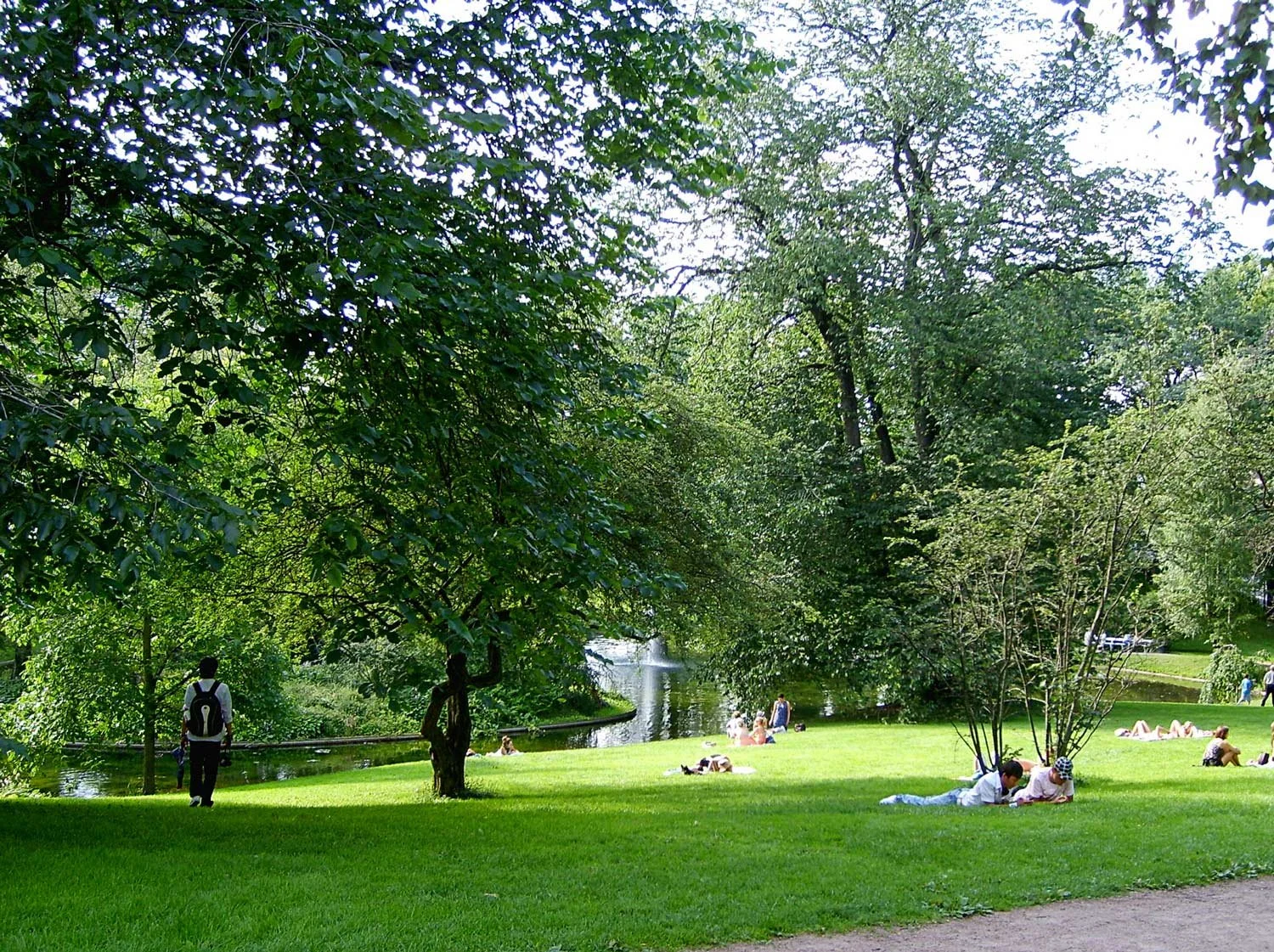
The Palace Park is one of Oslo's most eloquent public spaces. It is the garden of a working royal residence, the setting for national ceremonies and, at the same time, an everyday park where the city reads, walks, runs, talks, picnics and pauses. Few capital parks allow these identities to overlap so naturally. A visitor can stand before the country's head-of-state residence, watch the King's Guard complete its daily handover, turn into a shaded path and, within minutes, find ducks moving across a pond while someone nearby practises yoga or reads beneath an old beech.
The park does not rely on a single spectacular axis or a tightly controlled sequence of attractions. Its personality is revealed through contrast. The Palace Square is broad, exposed and ceremonial. Behind and beside it, the park becomes softer and more intimate. Gravel paths curve out of sight. Lawns rise and fall with the terrain. Mature trees interrupt long views. Water reflects leaves, sky and the pale Palace facade. The Queen's Park gathers the oldest history into a more enclosed garden. Elsewhere, meadow planting and children's sculpture bring the landscape firmly into the present.
This is why Slottsparken rewards more than a quick photograph. The Palace is its architectural centre, but the park is not merely a green frame around a monument. It is a living work of landscape design, shaped by political ambition, limited budgets, horticultural fashion, public use, royal history and contemporary ecological thinking.
## WHY THE PARK MATTERS
The Palace Park belongs to the first generation of major public parks in the Norwegian capital. It was planned while Christiania, as Oslo was then called, was growing beyond its older centre. The Royal Palace was placed on Bellevue Hill, west of the established town, and the approach that became Karl Johans gate helped pull the city's monumental centre towards it.
The park was open to the public from the beginning. That fact is central to its meaning. It was never simply a sealed royal garden glimpsed through gates. It became part of the city's daily geography, a route between the centre and neighbourhoods to the west, a green refuge and a setting in which the monarchy and the public could meet.
Today the park is protected as a cultural heritage landscape. The gardeners of the Royal Court maintain both a historical composition and a demanding urban ecosystem. They care for ancient trees, high-use lawns, flower beds, ponds, meadows, wildlife and the visual setting of a building that remains a residence, workplace and ceremonial stage.
## A HISTORY OF THE PALACE PARK
### The garden before the Palace
The oldest chapter of the park began well before the Palace. In 1751, mayor Christian Henrik Støedt created a private Rococo garden on the country property known as Sommerro. Its ordered beds, fruit trees, ornamental planting and useful garden reflected the formal taste of the period.
Bernt Anker, one of the most influential figures in Christiania's eighteenth-century elite, acquired Sommerro in 1778. He retained the formal garden while developing the surrounding land in a more naturalistic direction, with trees and orchard planting. Some of the oldest trees in today's Palace Park descend from this era. The historical Sommerro garden later became the core of Dronningparken, the Queen's Park.
### A Palace for the Norwegian capital
After 1814, Norway entered a union with Sweden while retaining its own constitution and institutions. The need for a suitable royal residence in Christiania became both a practical question and a symbol of the capital's status. The Storting, Norway's parliament, decided in 1822 that a royal residence should be built. The Danish-born architect Hans Ditlev Franciscus Linstow was commissioned to design it.
King Carl Johan selected Bellevue Hill as the site. The land was purchased in 1823, preparation began in 1824, and the King laid the foundation stone on 1 October 1825. The stone was placed at the intended site of the altar in the Palace Chapel, linking the ceremonial beginning of the building with one of its most important interior spaces.
Construction was slow and politically difficult. The original scheme was more ambitious and costly than the Norwegian economy and parliament would sustain. By 1827 much of the first allocation had been consumed by land purchases and groundwork, and building stopped until 1833. Linstow simplified his plans. The proposed H-shaped complex became the more restrained U-shaped building seen today. The exterior was largely complete by 1836, while the interiors took shape through the 1840s.
King Carl Johan died in 1844 and never lived in the Palace built for him. King Oscar I inherited the project. The facade was strengthened with its monumental columned centre, the wings were extended and the roofline altered. The Palace was taken over on the King's behalf on 15 March 1849 and formally inaugurated on 26 July that year.
### Building a Romantic landscape
The landscape developed alongside the architecture. Linstow took an active role in planning the grounds, while the first Palace gardener, Martin Mortensen, became increasingly important to their final form. Work advanced gradually from the late 1830s and continued into the 1850s. The combined park was established over the broader period from the 1820s to around 1860.
The main part of Sommerro was bought at auction in 1840 and incorporated into the new landscape. The purchases of Abelhaugen and Nisseberget in 1845 gave the park essentially the extent it has today.
The chosen language was Romantic rather than rigidly formal. Mid-nineteenth-century European garden design favoured an idealised nature: winding paths instead of uncompromising straight lines, softly modelled lawns, groups of trees, unexpected views and curving water. The Palace provided classical order; the park offered movement, shade and visual discovery. The ponds were dug by hand from around 1840, and their forms were adjusted repeatedly over roughly two decades.
### A public landscape in a growing city
As Oslo expanded westward, the park moved from the city's edge towards its centre. It became an important pedestrian route as well as a destination. The landscape changed over time: paths were widened or removed, planting matured, practical buildings were added and individual corners acquired names and monuments.
The great equestrian statue of King Carl Johan was unveiled in 1875, establishing the Palace Square as the monumental conclusion of the street that bears his name. Gustav Vigeland's monument to mathematician Niels Henrik Abel followed in 1908, and his portrait of author and women's rights pioneer Camilla Collett in 1911.
Until Norway dissolved its union with Sweden in 1905, the Palace was used mainly during royal visits. King Haakon VII and Queen Maud made it the permanent home of Norway's new royal family. The Palace required modernisation, and Queen Maud's interest in horses also influenced the expansion of the Royal Stables. The public ritual of the Royal Family greeting Oslo's children's parade from the Palace Balcony on Constitution Day began with King Haakon in 1906.
### War, return and remembrance
The German occupation from 1940 to 1945 altered the life of the park. Parts were used for growing potatoes, air-raid shelters were constructed and an area around the Palace was fenced with barbed wire. The grounds and square were also appropriated for occupation ceremonies and parades. These years remain a darker layer beneath the park's serene appearance.
On 7 June 1945 the landscape took on the opposite meaning. Immense crowds followed the returning Royal Family from the harbour towards the Palace after five years of exile. The square again became a place where national history was experienced collectively.
When King Olav V died on 17 January 1991, people transformed the Palace Square into a field of candles and flowers. The same ceremonial ground that accommodates official protocol had become a spontaneous place of public mourning.
### Restoration, art and ecology
Recent decades have brought careful restoration and new interpretation. Historic planting patterns and winding paths have been recovered in the Queen's Park. The formal garden south of the Palace has been recreated to evoke its appearance in the 1920s, with new benches made by Palace cabinetmakers after historical models.
Contemporary art has entered the grounds without erasing their historic character. Princess Ingrid Alexandra's Sculpture Park opened in 2016. Queen Sonja's hiking monument followed in 2017. Queen Sonja Art Stable opened the same year in the former Royal Stables, creating a public exhibition venue for the Royal Collections and contemporary art. Temporary projects have also appeared in the landscape, including Louise Bourgeois' monumental Maman in 2023.
Ecology now forms part of the park's visible identity. Large areas have been converted to flowering meadow, both to support pollinating insects and to reduce pressure around vulnerable old trees. Perennial beds extend the flowering season. The result is not a frozen nineteenth-century composition, but a historic park adapting carefully to contemporary knowledge.
## FINDING YOUR WAY AROUND
The Palace stands near the centre of the grounds, with the Palace Square and Karl Johans gate on the city-facing side. The main park wraps around the building. The Queen's Park occupies the more enclosed south-western part. Parkveien defines much of the western edge, while Wergelandsveien and the streets around Kunstnernes Hus and the House of Literature form the north-western boundary. Frederiks gate and the cultural quarter around the Historical Museum lie towards the east.
Two historic rises, Abelhaugen and Nisseberget, shape the transition between the park and the city on either side of the principal approach. The three ponds are Dronningdammen, Kongespeilet and Isdammen. Queen Sonja Art Stable has its public entrance at Parkveien 50, on the western side of the Palace complex.
There is no need to follow a fixed direction. For a first visit, however, the clearest introduction begins at the lower end of the Palace Square, continues around the Palace and historic statues, crosses the quieter park towards the ponds and the Queen's Park, and returns by way of Abelhaugen.
## THE PALACE SQUARE: NORWAY'S CEREMONIAL FORECOURT
Slottsplassen is not an ordinary plaza. It was conceived as a parade ground and remains Norway's principal royal ceremonial space. The broad gravel surface gives the Palace room to appear as a state building rather than simply a large house. Its openness also allows processions, guards, official arrivals and large public gatherings to be read from a distance.
Foreign heads of state are received here during state visits. New Norwegian governments have been presented here. The King inspects the Guard here. Concerts and drill displays can turn the square into an outdoor auditorium, while national celebrations fill it with people, flags and marching bands.
On 17 May, Norway's Constitution Day, Oslo's children's parade proceeds along Karl Johans gate and across the Palace Square. The Royal Family greets the procession from the balcony. For many Norwegians, the image of children, school banners, music and the Royal Family above the square is one of the defining images of the day.
At quieter times the square is a place for looking. Stand near the cityward terrace to understand the full composition: Karl Johans gate rises towards the Palace, the statue of King Carl Johan anchors the centre, rows of trees frame the space and the classical facade closes the view.
The square was renovated and given a new surface in 2012. It remains a working ceremonial area, so temporary barriers, security zones or event installations should be treated as part of the life of the site rather than as permanent features.
## THE ROYAL PALACE: A RESIDENCE, WORKPLACE AND NATIONAL STAGE
The Royal Palace is the official Oslo residence of the King and Queen. It is state-owned and placed at the disposal of the head of state. Members of the Royal Family have offices here, much of the Royal Court works here, and the building hosts audiences, meetings, councils, receptions, official dinners and visiting dignitaries.
Its exterior is deliberately restrained. The three-wing, three-storey composition is classically ordered, with a projecting central section, columns and balcony. The interiors are considerably richer and reflect the changing taste of the quarter-century during which the building was designed and completed. Summer tours may include rooms such as the Council Chamber, the White Drawing Room, the Bird Room, the Upper Vestibule, the Great Hall, the Ballroom and the Grand Dining Room. The route can vary from one season to another because this is an active Palace, not a static museum.
The Palace is open to general visitors only through organised guided tours, normally during a summer season from late June to mid-August. English-language tours are offered, and advance purchase is strongly recommended. The tour entrance is behind the Palace on its western side, not on the Palace Square facade.
The balcony has an exceptional symbolic role. It is the point from which the Royal Family meets the national-day crowds, but it is also a piece of Linstow's architectural staging, visually connecting the state rooms inside with the ceremonial city outside.
## READ THE FLAG ABOVE THE PALACE
The roof flag tells an informed visitor something about the constitutional moment. The Royal Standard, a golden Norwegian lion with a silver axe on red, is normally flown when the King is in Norway or Norwegian territory. When the King is abroad and the Crown Prince acts as Regent, the Crown Prince's swallow-tailed standard is used. If both are abroad, the State Flag is flown.
There are exceptions. If the King is at Stiftsgården in Trondheim or aboard the Royal Yacht Norge in Norwegian waters, the Royal Standard is flown there and the Palace flagpole may be bare. The royal standards can remain aloft around the clock; the State Flag follows ordinary flag hours.
This small piece of visual knowledge turns a photograph of the facade into a reading of Norway's living constitutional monarchy.
## THE CHANGING OF THE GUARD
His Majesty the King's Guard has maintained sentry duty at the Royal Palace since 1888. The main ceremonial handover normally takes place every day at 13:30. It is free to watch and is one of the easiest royal traditions for an international visitor to experience.
The basic daily handover should not be confused with the more elaborate summer guard parades. On selected dates between spring and early autumn, a military band may lead the incoming guard from Akershus Fortress, departing around 13:10 and reaching the Palace Square at about 13:30. A concert or drill display may follow. These enhanced programmes are date-specific and may be cancelled at short notice, particularly in poor weather. Check the Norwegian Armed Forces and Royal Court calendars before planning a visit around one.
Arrive 10 to 15 minutes early for the normal ceremony and earlier for a parade or drill display. Keep the working area clear, follow instructions and do not obstruct the guards. The ceremony is dignified but not theatrical in the theme-park sense: the soldiers are carrying out an actual security duty.
## THE GUARDHOUSE
The small Guardhouse beside the Palace Square is easy to overlook in the scale of its surroundings. It was designed by Linstow and erected in the 1840s. The Royal Court describes it as one of Norway's earliest buildings in the Swiss style. Linstow encountered the style while travelling in Germany and believed its expressive timber architecture related naturally to Norwegian building traditions.
The building has served the King's Guard since it was first used. Intended as a temporary solution, it survived, remained functional and is now protected. Its modest scale and picturesque roofline provide an instructive counterpoint to the classical Palace.
## THE PALACE HILL, TERRACE AND CEREMONIAL APPROACH
The rise from Karl Johans gate is commonly understood as Slottsbakken, the Palace Hill. This is the cityward threshold of the entire ensemble. From below, the Palace appears elevated and distant; from above, the view opens back along Oslo's principal ceremonial street.
The terrace, steps, balustrades and historic lamp standards around the Carl Johan monument reinforce the formal transition from street to Palace Square. They were added in connection with the 1875 monument. The composition is especially effective in low morning or evening light, when the modelling of the statue, balustrade and Palace facade becomes more legible.
The sloping edges are planted rather than treated as mere leftover ground. Old lilacs in this part of the park are a particularly loved spring feature, sometimes reaching their best around Constitution Day.
## ABELHAUGEN: SCIENCE, SCULPTURE AND CITY VIEWS
Abelhaugen is one of the two historic rises at the cityward edge of the park. Its identity is inseparable from Gustav Vigeland's monument to the mathematician Niels Henrik Abel. The bronze stands on an eight-metre granite pedestal; the complete monument rises more than twelve metres and dominates its compact hilltop setting.
Abel died in 1829 at only 26, but his mathematical work had a profound international influence. The annual Abel Prize, one of the world's leading honours in mathematics, bears his name, and laureates traditionally lay a wreath at the monument.
Vigeland's work is not a conventional quiet portrait. It presents youthful intellectual force in a heroic and symbolic form. Its height makes it visible across the surrounding streets and lawns, while the hill creates a useful visual and physical link between park and city. Perennial and rose planting around Abelhaugen softens the monument's great vertical emphasis.
For visitors interested in Vigeland, this and the Camilla Collett monument show an earlier, portrait-based side of the sculptor's career, quite different in scale and purpose from the later installation at Vigeland Park.
## NISSEBERGET: THE OTHER CITYWARD RISE
Nisseberget balances Abelhaugen on the opposite side of the Palace approach. Both areas were acquired in 1845 and helped establish the park's present extent. Their undulating ground preserves the Romantic preference for varied terrain at the meeting point between formal city and naturalistic park.
Nisseberget has had several lives. In the late nineteenth century a popular observatory operated on one of the park's cityward rises, part of a period when public science and urban leisure often occupied the same places. Today the value of Nisseberget lies less in a single headline attraction than in its trees, paths, planting and changing views of the Palace ensemble.
## THE MAIN PARK: LAWNS, PATHS AND OLD TREES
Beyond the ceremonial square, the main park becomes an urban landscape for everyday life. Curving gravel paths lead between large lawns and groups of deciduous trees. The terrain is gently varied rather than flat. It offers both broad, social spaces and smaller pockets of quiet.
Visitors may walk and sit on the grass unless an area has been temporarily marked as newly seeded or vulnerable. This permission is important: the lawns are not merely to be admired from paths. They are where families spread a picnic blanket, friends meet after work, children run, travellers rest and solitary visitors read beneath the canopy.
The paths are also used as cross-city routes. Joggers are welcome, but running and cycling should remain on the gravel walks. Cyclists are asked to move at walking speed, about 5 km/h, and always give priority to people on foot. Anyone travelling quickly is better served by streets or cycle routes outside the park.
The main park is open around the clock, but 24-hour access should not be mistaken for continuous staffing. After dark, use ordinary urban awareness and choose a route suited to weather, visibility and your comfort.
## THE QUEEN'S PARK: A GARDEN WITHIN THE PARK
Dronningparken is the most historically layered and horticulturally intimate part of the Palace Park. Its origins reach back to the Sommerro garden of 1751, making it older than the Royal Palace by almost a century. It was incorporated into the Palace landscape after the property was acquired in 1840.
The Queen's Park retains the broad character of a Romantic garden while preserving traces of its older, more formal identity. Mature trees create a deep canopy. Curving walks reveal water, flower borders, lawns and small architectural elements gradually. The atmosphere is more enclosed than in the main park, and the seasonal gates make the visit feel distinct.
Among its great natural treasures is an immense weeping beech, part of a tree population that includes specimens dating from the eighteenth century. The gardeners have restored older elements, including paths and beds, while introducing long-season perennial planting. The flower display changes from year to year, so no single plant list can describe the garden permanently.
The Queen's Park is free, but unlike the rest of the grounds it has fixed seasonal hours. The established annual pattern is 18 May to 1 October, daily from 07:00 to 20:00. Gates can be affected by official use or essential work, so verify before a special journey.
Ball games are not allowed here, even though considerate ball play is permitted in the main Palace Park. Treat the Queen's Park as a garden for walking, looking and quiet rest.
## THE RESTORED FORMAL GARDEN
South of the Palace, an important formal section has been recreated to evoke its appearance in the 1920s. Here the composition becomes more ordered, offering a deliberate counterpoint to the surrounding Romantic curves. Carefully shaped beds, changing seasonal planting and historically informed seating establish a more architectural garden room.
The Palace's cabinetmakers produced new benches based on models used about a century earlier. A ceramic vessel by Norwegian artist Gunhild Rudjord has also been given a permanent place in the Queen's Park. The planting changes, but the design principle remains: a disciplined foreground to the Palace's southern wing, restored through craftsmanship rather than imitation alone.
## THE SWISS-STYLE PAVILION
An octagonal pavilion, built between 1854 and 1857, stands among the trees in the Queen's Park. Its Swiss-style architecture belongs to the same nineteenth-century fascination seen in the Guardhouse, though the pavilion is more explicitly recreational and picturesque.
It is one of the most evocative places in the park: a small structure designed to be encountered on a walk, framed by foliage rather than monumental space. It has occasionally been used for special literary projects, but visitors should not assume it operates as a permanent library or staffed attraction. Its everyday pleasure is visual: architecture at the scale of a garden, discovered beneath mature trees.
## THE THREE PONDS
Water is essential to the Palace Park's Romantic character. The three ponds cover approximately 5,200 square metres and together hold about five million litres of water. Their curving edges, reflections and fountains soften the traffic noise and create habitats for birds, insects and aquatic life.
### Dronningdammen, the Queen's Pond
Dronningdammen is one of the two largest ponds. Together with Kongespeilet it forms the most atmospheric water landscape in the grounds. Branches reach over the surface, fountains and moving water introduce sound, and ducklings are a familiar spring sight. The pond is best appreciated slowly and from a respectful distance, especially when nesting birds or young waterfowl are present.
### Kongespeilet, the King's Mirror
Kongespeilet, the King's Mirror, is the other large pond. Its name suits a landscape designed around reflection. Queen Sonja's hiking statue stands beside it, turning the water into both a natural scene and a setting for portrait sculpture.
The title also echoes the name of a famous medieval Norwegian didactic text, although the park pond is first and foremost understood through its mirror-like role in the landscape.
### Isdammen, the Ice Pond
Isdammen lies near the corner of Parkveien and Wergelandsveien. Its name preserves a practical history. Ice was once cut here in winter for the Palace ice cellar and for breweries in nearby Pilestredet. The pond disappeared towards the end of the nineteenth century and was re-established around 1998, returning water to a part of the park where an earlier pond had existed.
The ornamental ponds are places to observe, not to enter. Keep children close to the edges, keep dogs leashed and allow wildlife space. Fountain operation and water levels can vary with season, maintenance and weather.
## CROWN PRINCESS MÄRTHA'S GARDEN
Near the statue of Crown Princess Märtha, flowering ornamental cherry trees create one of the park's most recognisable spring scenes. The place is known as Kronprinsesse Märthas hage, Crown Princess Märtha's Garden.
The sculpture and planting work together. The blossoms bring a brief, luminous canopy around a portrait associated with courage, public service and the wartime relationship between Norway and the United States. Because the flowering period is short and weather-dependent, visitors should regard it as a seasonal gift rather than a fixed date in the calendar.
## SEVEN HISTORIC STATUES AND SCULPTURES
The Royal Court counts seven statues and sculptures in the Palace Park, in addition to the twelve works in Princess Ingrid Alexandra's Sculpture Park. Together they form an unusually varied outdoor collection, embracing monarchy, literature, mathematics, women's rights, outdoor life and an animal study.
### King Carl Johan, Brynjulf Bergslien, 1875
The equestrian monument in the Palace Square is the oldest and largest of the park's major statues. Brynjulf Bergslien won the commission after public opinion strongly favoured a Norwegian sculptor. Cast in Copenhagen, the bronze was unveiled by King Oscar II on 7 September 1875.
Carl Johan laid the Palace foundation stone and gave his name to the street extending from the square. The mounted figure faces the city, binding monarch, Palace and urban axis into a single composition.
### Niels Henrik Abel, Gustav Vigeland, 1908
Vigeland's towering Abel monument stands on Abelhaugen. It was unveiled on 17 October 1908. The clay model was ceremonially destroyed after casting so that the work could not be replicated. More symbol than literal portrait, the monument converts the story of a young mathematical genius into physical ascent and intellectual energy.
### Camilla Collett, Gustav Vigeland, 1911
The Norwegian Association for Women's Rights initiated the monument to author and women's rights pioneer Camilla Collett. Vigeland produced more than one hundred drawings and several sculptural studies before settling on the final form.
The bronze is known as I storm, In the Storm. It depicts an older Collett drawing her shawl around herself against the wind. Rather than idealising her as an untouchable heroine, Vigeland presents age, resistance and solitude. It is one of the most psychologically compelling public portraits in Oslo.
### Queen Maud, Ada Madsen, 1959
Ada Madsen's granite statue of Queen Maud stands at the entrance to the Queen's Park. King Olav V unveiled it in 1959. The surrounding planting is treated as part of the composition. Seen from above, beds and clipped forms have been arranged to suggest a train, veil and tiara around the Queen.
### The Roe Deer, Arne N. Vigeland, 1953
The smallest sculpture in the park is a bronze roe deer in the Queen's Park. Arne N. Vigeland created it in 1953. It was moved from Bygdø Royal Farm after the change of reign in 1991. Its scale and animal subject make it easy to miss, which is part of its charm: a quiet discovery within the garden rather than a formal public monument.
### Crown Princess Märtha, Kirsten Kokkin, 2007
Kirsten Kokkin's bronze stands near the Guardhouse. It was a gift from the Storting for King Harald's seventieth birthday and was unveiled by the King on 21 February 2007. The portrait commemorates Crown Princess Märtha's energy and determination, including her work for Norway in the United States during the Second World War. A corresponding sculpture stands at the Norwegian ambassador's residence in Washington, D.C.
### Queen Sonja, The Hiking Queen, Kirsten Kokkin, 2017
Kokkin also created the newest of the seven works. Turdronningen, The Hiking Queen, was unveiled on Queen Sonja's eightieth birthday, 4 July 2017. It was a gift from the Norwegian Trekking Association.
The bronze shows the Queen in hiking clothes, seated with her rucksack beside her and looking towards the Palace. She rests on granite from Hedalen in Valdres. The portrayal is intentionally informal and specific: the Queen as an experienced mountain walker reflecting after another ascent. Its position beside Kongespeilet gives the work a calm, contemplative setting.
## PRINCESS INGRID ALEXANDRA'S SCULPTURE PARK
Princess Ingrid Alexandra's Sculpture Park is one of the most original parts of the grounds: a park of art for children, based on ideas created by children. It opened on 19 May 2016 as part of the celebration of King Harald and Queen Sonja's twenty-five years as Norway's royal couple.
The sculpture park is open throughout the year and admission is free. It belongs to the everyday life of the main Palace Park rather than to the seasonally gated Queen's Park.
Designs were selected through competitions among fifth- and sixth-grade pupils across Norway. Professional artists and craftspeople transformed the winning drawings into durable works while keeping the children's concepts as the governing designs. The final additions were installed in 2019. The collection now comprises twelve works, including Putemann, an earlier children's sculpture transferred from the sculpture trail at Akershus Fortress.
The works are meant to be encountered physically. At the opening, the King made clear that children could touch and use them, not simply look from a distance. Families should still follow any current signs or maintenance barriers and help younger visitors share the sculptures safely.
### The twelve works
1. Kanin i trøbbel, Rabbit in Trouble, 2016. Designed by Emma Hansen of Ballangen School and realised with artist Ellen Solberg in powder-coated bronze. The oversized white rabbit head, with long ears and a startled expression, turns a universally recognisable moment of alarm into comic public art.
2. Geometrisk rev, Geometric Fox, 2016. Designed by Sofie Sollid Gjertsen of Setermoen School and realised with Harald Fossen in powder-coated steel. Angular planes give the alert orange fox the energy of a folded drawing brought into three dimensions.
3. Putemann, Pillow Man. Designed by Jonas Gjerstad, Martin Danning and Mathias Svendsen of Sagdalen School. This playful figure predates the formal competition series and came to the Palace Park from the children's sculpture trail at Akershus Fortress.
4. Ansiktsløs mann, Faceless Man, 2017. Designed by Evald Møller Johansen of Lilleby School and realised with Ellen Solberg in bronze. A seated human figure has no facial features, while a bird-like puppet on the hand seems to carry the power of expression. The result is both strange and quietly poetic.
5. Roggbif, 2017. Designed by Emilie Forsmo Bratberg and Kaisa Øksdahl of Slåstad School, and realised with Fredrik Raddum in powder-coated aluminium. The title is the Norwegian acronym for the colours of the rainbow. Visitors pass beneath the coloured arcs, making the work a portal as well as a sculpture.
6. Instrument, 2018. Designed by Norah Hansen of Kringler-Slattum School and realised with Fredrik Raddum in glass. The translucent, abstract form resembles a fantastical instrument while resisting a single explanation.
7. Mitt mot, My Courage, 2018. Designed by Christian Mathias Andresen of Moss International School and cast in bronze. The image of a melting human figure gives physical form to uncertainty, nervousness and the effort required to find courage.
8. Jordas hånd, Earth's Hand, 2018. Designed by Helene Breen Brudevoll of Botne School and realised with Magnus Berntz Eriksen in stone. A giant hand cradles planting and a tree, turning care for the planet into a direct, graspable image.
9. Den store marken, The Great Worm, 2018. Designed by Nicklas Eskedal-Christophersen, Oliver Kristoffer Brækken, Julian Malachi Kumar Karpis and Kristoffer Bentzen-Lunder of Eikeli School, and realised with Ellen Solberg in bronze. The enlarged earthworm celebrates one of the modest creatures on which fertile soil depends.
10. Tallblyanten på rømmen, Number Pencil on the Run, 2019. Designed by Lise Margrethe Kvernvold of Vaulen School and realised with Harald Fossen in welded aluminium tube and powder-coated elements. The escaped pencil twists dynamically through the air, somewhere between schoolroom object and animated character.
11. Munnben, literally Mouth Legs, 2019. Designed by Emma Sofie Nesse Torgersen of Tysnes School and realised with Magnus Berntz Eriksen in powder-coated bronze. A large mouth stands independently on legs, an absurd and expressive combination that is difficult to pass without reacting.
12. Rar benk, Strange Bench, 2019. Designed by August Kristoffer Mortensen Vassdal of Paradis School and realised with Harald Fossen in powder-coated acid-resistant steel. Blue cubes of different heights become both sculpture and seating, inviting play, pause and social use.
The sculpture park works especially well when adults resist the urge to explain everything. Ask children what they see, which work they would climb into a story, and what sculpture they would design for the next generation.
## QUEEN SONJA ART STABLE
Dronning Sonja KunstStall, Queen Sonja Art Stable, is the principal museum and exhibition venue within the Palace complex. It occupies the former Royal Stables at Parkveien 50. The stable buildings date from 1848, while later development created a larger equestrian facility. The last horses left in 1940. After decades of storage and garage use, the complex reopened in 2017 as a venue for art, culture and history.
The Middle Stable preserves the rhythm of the old stalls, now used to frame exhibition displays. The historic Harness Room is normally part of the visitor experience. Here state and private carriage equipment, saddles, harnesses and accessories remain associated with the horses and vehicles for which they were individually fitted. Decorative rosettes, crowns and royal coats of arms turn practical equipment into material history.
The Riding Hall, restored in full by 2023, provides approximately 800 square metres for larger exhibitions and events. The programme often brings objects from the Royal Collections into dialogue with modern and contemporary art. Earlier subjects have ranged from royal transport and ceremonial craft to Sami art, Edvard Munch and collaborations with the National Museum.
The Art Stable is accessible by a gentle ramp, and the exhibitions are on one level. Wheelchairs are available to borrow, benches are provided and accessible toilets are on the premises. Photography is generally permitted, though visitors should always respect any exhibition-specific notice. Food and drink are not allowed in the galleries.
During the summer season there is normally an outdoor cafe in the stable courtyard. The museum shop sells books, postcards and royal-themed gifts. Opening days change between the summer period and the rest of the exhibition season, and the venue closes while exhibitions are being installed. Always check the current programme before travelling.
## GROTTEN AND THE CULTURAL EDGE OF THE PARK
At Wergelandsveien 4, on a rocky edge of the Palace Park, stands Grotten. The poet Henrik Wergeland built the house in 1841 and lived there until 1845. Its name comes from the grotto beneath it, formed from an excavated rock passage and used by Wergeland as a small work and collection space.
Since 1924 Grotten has served as the Norwegian state's honorary residence for artists. It is a private home, not a regular visitor attraction. Appreciate it from the public realm and respect the resident's privacy. Its importance lies in the unusual meeting of literature, architecture and state recognition at the park boundary.
Nearby are other working and historic estate buildings: old gate lodges, the Palace administrator's residence, service structures, the gardeners' complex and greenhouses. They are part of the protected ensemble but should not be treated as public museums. Their presence is a reminder that the park is actively maintained and the Palace remains a working institution.
## FLOWERS, TREES AND BIODIVERSITY
The park contains around 1,000 trees, some more than 250 years old. They are not background decoration; they are the structural framework of the landscape. Their trunks, canopies, shade, root zones and seasonal change give the park its scale and atmosphere.
The historic tree population includes venerable specimens from the former Sommerro garden, along with later plantings from the first decades of the Palace Park. A giant weeping beech in the Queen's Park is among the most memorable. Old lime trees, flowering cherries, magnolias, lilacs and many other deciduous species contribute different forms and seasons.
Spring begins close to the ground. Crocuses spread colour through the lawns, and daffodils create broad drifts, particularly along the southern avenue. Tulips gather around Queen Maud, while magnolia and ornamental cherry blossom make brief but anticipated appearances.
Summer shifts attention to perennial beds and meadow. Alliums, echinacea, agapanthus and changing annual combinations have appeared in the formal and informal planting. Butterflies, bees and other pollinators follow. Large areas of flowering meadow, together covering an area comparable to six football fields, reduce intensive mowing and help protect the root zones of old trees.
### A flower trail through the grounds
The scale of the spring display is easy to underestimate. A quarter of a million crocus bulbs were planted for the 2005 centenary of Norway's dissolution of the union with Sweden, and many still return each spring. Thousands of narcissi can turn the southern avenue, Søndre allé, into a pale river in April and May. Ornamental cherry gathers around Crown Princess Märtha's statue; lilacs scent the Palace Hill; imperial fritillaries appear on Nisseberget; tulips and changing seasonal designs frame Queen Maud. Later, the emphasis moves to the perennial beds around Isdammen, the Queen's Park and the Parkveien side. Exact timing and combinations vary with the weather and the gardeners' annual plans, which is part of the pleasure of returning.
Autumn belongs to the canopy, seed heads and quieter colour. The Queen's Park can be especially atmospheric before its seasonal closure on 1 October. Winter reveals the design in another way: trunks, path curves, topography, statues and the Palace architecture become more visible. Snow can make the square magnificent, but ice and compacted snow can also make gravel paths and slopes difficult.
Visitors can help preserve this living heritage. Do not climb trees, hang from branches or attach hammocks, slacklines, exercise bands or other equipment. Do not pick flowers, including meadow flowers, and do not enter planted beds. Old trees can be damaged by actions that appear harmless at the scale of a single visit.
## THINGS TO DO IN THE PALACE PARK
### Walk without an agenda
The simplest activity is the best introduction. Choose a curving path, let the Palace disappear behind foliage and notice how often the landscape changes. A complete circuit can feel surprisingly varied for a park of this size.
### Watch the changing of the guard
Plan to be at the Palace Square before 13:30. On selected summer dates, combine the handover with a parade, music or drill display. Check the official schedule because enhanced events are not daily and weather may intervene.
### Have a picnic
Picnics are welcome in the main park and the Queen's Park. Bring food that is easy to carry and leave no trace. Use the waste bins or take everything away with you. Grilling and open-fire cooking are not permitted.
The lawns make a relaxed lunch setting, but avoid newly seeded, wet or signed-off ground. Choose a place that does not block a path, crowd a sculpture or press against the root flare of an ancient tree.
### Read under a tree
Slottsparken may be Oslo's most literary central park. Camilla Collett stands within it, Henrik Wergeland's Grotten touches its edge, Henrik Ibsen lived across the road and the House of Literature is close by. Bring a book, choose a bench or dry patch of lawn and allow the setting to become part of the reading.
### Sit beside the water
The ponds are places for unhurried attention. Watch reflections, fountain spray, leaves and waterfowl. Spring ducklings are especially popular with families. Observe without chasing or crowding the birds, and keep dogs under control.
### Jog
Running is allowed on the gravel paths. A loop through the park is short enough to repeat and varied enough to remain interesting, but this is a shared pedestrian landscape. Slow down around children, busy junctions, the sculpture park and ceremonial activity. Do not use historic benches as exercise apparatus.
### Cycle gently
Cycling is permitted only on the gravel paths and at no more than about walking speed. The park is useful as a calm connector, not as a fast training route. Dismount when crowds, ceremonies or narrow spaces make riding inconsiderate.
### Meditate or practise yoga
Personal meditation, quiet stretching and small-scale yoga on a suitable lawn can be a rewarding way to use the park. Choose level, dry ground away from formal beds, ceremonies, busy paths and nesting wildlife. Keep the activity private and low-impact. Commercial instruction or organised income-generating activity requires permission, and equipment must never be attached to trees.
### Play and move
Children may run on the lawns, and considerate ball games are allowed in the main park. Permanent or temporary goals, nets and similar structures may not be erected. Ball play is not allowed in the Queen's Park or around Oscarshall. Always yield to other visitors and protect plants and trees.
### Study sculpture
The seven historic monuments create a compact lesson in Norwegian public memory. The children's sculpture park offers a radically different idea of who can shape public art. Visiting both collections in one walk makes the contrast especially rewarding.
### Photograph the landscape
Outdoor photography for ordinary personal use is allowed. The Palace facade, water reflections, spring blossom, autumn foliage and silhouettes of statues all reward changing light. Formal filming requires advance permission from the Royal Court. Photography is not permitted inside the Royal Palace, while it is generally allowed at Queen Sonja Art Stable unless a current exhibition states otherwise.
## A FAMILY DAY IN THE PARK
The park works well for families because it offers movement without requiring a ticket. Begin with the Palace Square and the guards, continue to Princess Ingrid Alexandra's Sculpture Park, then choose a lawn for a snack or picnic. Add the ponds for ducks and reflections, but hold young children close at the water's edge.
The children's sculptures are designed to invite touch and play. Encourage imaginative use while respecting other families and any temporary maintenance signs. The main lawns provide space to run, but the Queen's Park should be treated as a quieter garden and does not permit ball games.
There is no general indoor family base in the open park, so plan for weather and toilets. Queen Sonja Art Stable provides indoor culture, accessible toilets and seating during opening hours. The House of Literature and Kunstnernes Hus are also useful nearby breaks, but their programmes and dining operations should be checked in advance.
For a calm family visit, weekday mornings are often easier than a sunny weekend afternoon. For ceremonial excitement, arrive before the 13:30 guard change. On 17 May, expect an entirely different experience: exceptional crowds, security arrangements and transport changes.
## THE PARK THROUGH THE SEASONS
### Spring
Spring is the season of sequence: crocus, daffodil, tulip, magnolia, cherry and lilac. Exact timing varies with weather. The Queen's Park remains closed until 18 May, so early spring visitors explore the main grounds. The period around 17 May is visually splendid but exceptionally busy.
### Summer
Summer brings the fullest visitor programme. The Queen's Park is open, the perennial borders are active, the lawns fill with picnics and the Palace normally offers guided tours. Queen Sonja Art Stable usually operates daily during the Palace tour season, with an outdoor courtyard cafe. This is also the period in which enhanced guard parades, concerts or temporary art projects are most likely.
### Autumn
September offers a productive balance of colour, lower visitor pressure and continued access to the Queen's Park until 1 October. After the seasonal gate closes, the main park remains open. Wet leaves and soft ground require care, especially on slopes.
### Winter
The main park and square remain open. Snow simplifies the landscape and makes the Palace composition particularly clear. Winter also exposes the old trees' architecture and gives the statues stronger silhouettes. Wear footwear suited to ice, and do not assume every minor path will be equally easy after snowfall.
## THREE SELF-GUIDED VISITS
### The 30-minute ceremonial introduction
Start at the lower end of the Palace Square. Study the equestrian statue of King Carl Johan, look back along Karl Johans gate, cross the square and examine the Palace facade, flag and Guardhouse. If possible, time the visit for the 13:30 changing of the guard. Finish with a short turn into the adjacent park to experience the sudden change from ceremony to landscape.
### The 60-to-90-minute complete park walk
Begin at the Palace Square and Carl Johan monument. Pass the Guardhouse and Crown Princess Märtha's Garden, then explore the historic statues and Princess Ingrid Alexandra's Sculpture Park. Continue through the main lawns and old trees towards Isdammen and the Parkveien side. If the seasonal gates are open, enter the Queen's Park for the pavilion, formal garden, Queen Maud monument, roe deer sculpture and mature trees. Continue by Dronningdammen and Kongespeilet, pause at Queen Sonja's hiking monument, then return by Abelhaugen and its towering Abel monument.
Because paths, gates and temporary work zones can change, treat this as a sequence of highlights rather than turn-by-turn navigation.
### The half-day royal culture visit
Reserve a summer Palace tour in advance. Arrive early, allowing time to find the west-side tour entrance and complete security procedures. After the tour, use the same-day admission arrangement for Queen Sonja Art Stable when offered. Add lunch or coffee at the seasonal Stable Courtyard cafe, Kafe Oslo at the House of Literature or Juret at Kunstnernes Hus. End with a slow walk through the Queen's Park and ponds.
## FOOD AND DRINK
There is no permanent year-round restaurant in the open park itself. Picnics are therefore part of the authentic local experience, while several strong cultural dining options sit immediately outside the grounds.
### Stable Courtyard cafe
During the summer season, an outdoor cafe normally operates in the courtyard at Queen Sonja Art Stable, entrance Parkveien 50. It is the only regular seasonal cafe within the Palace complex. Operation follows the Art Stable season and can be affected by exhibition changeovers. Food and drink may not be brought into the galleries or Palace.
### Kafe Oslo at the House of Literature
Kafe Oslo occupies the ground floor of Litteraturhuset, the House of Literature, at Wergelandsveien 29. It serves everything from coffee and small dishes to full meals. The adjoining LesBar is conceived as a relaxed reading area; current house information states that visitors can sit there with a book, newspaper or magazine without an obligation to order food. It is a particularly natural extension of a reading visit to the park.
### Juret at Kunstnernes Hus
Kunstnernes Hus, Wergelandsveien 17, overlooks the park edge. Its current eatery and bar is Juret, serving baked goods, breakfast and lunch dishes, dinner and drinks, with indoor and outdoor seating in season. Older guides may refer to Lofthus Samvirkelag at this location; that information is outdated as of this edition.
### Theatercafeen
At Stortingsgata 24/26 beside Nationaltheatret, Theatercafeen offers a more formal historic Oslo dining experience. It has long associations with actors, artists and city cultural life. It is a useful choice before or after an evening performance or for visitors who want table service rather than a park picnic.
### Grand Cafe
Grand Cafe at Karl Johans gate 31 lies along the ceremonial route below the Palace. Opened in 1874, it is part of Oslo's literary and artistic history and was frequented by figures including Henrik Ibsen and Edvard Munch. It is a fitting stop for visitors walking between Oslo Central Station and the Palace Park.
Restaurant names, menus and hours are especially vulnerable to change. Use the official links at the end to confirm service on the day.
## TOILETS
Do not assume that the open lawns and paths provide a clearly signed, standalone, year-round public toilet.
- Queen Sonja Art Stable has public toilets during opening hours, including an accessible toilet.
- The Royal Palace has toilets near the tour cloakroom and accessible facilities inside, intended for Palace visitors during the summer tour operation.
- Nearby staffed cultural venues and transport hubs may provide facilities according to their own access rules and hours.
Families and visitors with medical or accessibility needs should plan a toilet stop before entering the quieter parts of the grounds, particularly outside the summer season.
## HOW TO GET THERE
### On foot
Walking is the most rewarding arrival. From Oslo Central Station, follow Karl Johans gate west through the city centre to the Palace Square. Allow roughly 20 to 25 minutes at a comfortable pace, longer if you stop at the Cathedral, Storting or university buildings.
From Oslo City Hall, the National Museum, Aker Brygge or the Nobel Peace Center, the park is approximately 10 to 15 minutes on foot, depending on the entrance and pace. From Nationaltheatret, the Palace Square and southern park entrances are only a few minutes away.
### By metro
Nationaltheatret is the nearest metro station. In normal operation, central metro lines stop here. Follow signs towards the city, National Theatre or park side, then use street-level wayfinding for the entrance you need. Service patterns can change during major engineering projects, so check Ruter on the day.
### By train
Nationaltheatret is also a railway station. Local and regional trains, and airport rail services, stop here according to the current timetable. This makes the park an easy first or final stop for travellers with light luggage. Use the train operator's journey planner for the exact service.
### By tram and bus
Stops around Nationaltheatret serve the Palace Square and southern side of the park. Solli plass is useful for Queen Sonja Art Stable and the Parkveien side. Routes and stop patterns change, particularly during city-centre events and construction, so search for Slottsplassen 1 or Parkveien 50 in the Ruter journey planner rather than relying on a printed line number.
### From Oslo Airport
Airport Express and Vy train services connect Oslo Airport with Nationaltheatret according to the current timetable. From the station, walk a few minutes to the park. This is generally the clearest public-transport route for international arrivals.
### By bicycle
Oslo's cycle network and city-bike system make the park easy to reach. Inside the park, cycle only on gravel paths, give complete priority to pedestrians and keep to about 5 km/h. If you intend to continue at normal cycling speed, use the surrounding street network. Park bicycles only where they do not obstruct gates, paths, accessibility or ceremonial areas, and secure them responsibly.
### By car or taxi
There is no visitor parking at the Royal Palace, and cars and coaches may not park within the Palace grounds. Public transport is usually easier. The Royal Court identifies the junction of Parkveien and Riddervolds gate as the nearest practical drop-off point for Palace visitors arriving by car or taxi, especially for mobility access.
For parking elsewhere, use the City of Oslo's current parking map and obey on-street signs. Regulations, prices and temporary restrictions change. Never use the park itself or a Palace gate as an informal stopping place.
## ACCESSIBILITY
The Palace Square and many principal park routes can be experienced without stairs, but the protected historic landscape is not uniformly level or paved. Surfaces are mainly gravel, the terrain rises and falls, and conditions vary with rain, snow and ice. Abelhaugen, Nisseberget and minor paths may be less comfortable for wheelchairs, rollators or visitors with limited balance.
A practical lower-gradient visit can concentrate on the Palace Square, broad main paths, selected lawn edges and Queen Sonja Art Stable. The Art Stable has a gentle entrance ramp, a one-level exhibition, wheelchairs for loan, benches and an accessible toilet.
The Palace itself was completed in 1849 and does not meet modern accessibility standards throughout. Summer tours cover two floors. A small lift is available, and wheelchairs, rollators and folding chairs can be provided, but large electric wheelchairs may require a modified one-floor route. Wheelchair users are asked to arrive at the ticket office behind the Palace 20 minutes before their tour and should review the current dimensions and booking advice on the official page.
Most Oslo city buses, metro trains and newer trams are low-floor or otherwise adapted, but platform gaps and older vehicles can create difficulties. Ruter's app provides current accessibility information. At Nationaltheatret metro station, a height difference can exist between train and platform, so users who require step-free precision should check the latest guidance.
## PARK RULES AND GOOD ETIQUETTE
The rules protect a heavily used public space, a working royal residence and a fragile historic landscape.
- Picnics are welcome. Grilling is not permitted.
- Dogs are welcome but must remain on a leash throughout the year. Keep them out of beds and clean up after them.
- Walking, sitting and lying on established lawns are allowed unless signs protect newly seeded or vulnerable ground.
- Do not pick planted or wild flowers.
- Do not enter flower beds.
- Do not climb trees or hang from branches.
- Hammocks, slacklines, exercise bands and similar equipment may not be attached to trees.
- Jogging and cycling are allowed on gravel paths. Cycling should be at walking speed.
- Considerate ball play is allowed in the main park, but goals, nets and similar installations may not be erected. Ball play is not allowed in the Queen's Park.
- Do not use historic benches for jumps or exercise routines.
- Tents and overnight camping are not permitted.
- Motorised vehicles may not enter or park in the grounds without authorisation.
- Benches, bins and other park furniture must not be moved.
- Commercial sales, collections, recruitment, advertising, paid training and similar income-generating activity require authorisation and are generally not permitted as casual park use.
- Ordinary photography is welcome. Formal or commercial filming requires permission.
- Follow temporary signs, barriers and instructions related to ceremonies, security, wildlife, weather or maintenance.
## SPECIAL DAYS AND EVENTS
### Constitution Day, 17 May
This is the park's most famous public day and its least ordinary. The children's parade, Royal Family balcony appearance, marching bands, crowds, security checks, access arrangements and public-transport diversions transform the area. Visit for the national celebration, not for a quiet park walk. Check the City of Oslo, Ruter and Royal Court information shortly before the date.
### State visits and official ceremonies
The Palace Square may be used for formal arrivals, Guard inspections and presentations. Public access can be redirected. These events reveal the square's real constitutional function, but visitors must follow police and Palace instructions.
### Concerts, exhibitions and temporary art
The grounds have hosted free concerts, outdoor cinema, royal garden parties and temporary sculpture. Such events are occasional rather than permanent. The absence of an event on one visit is not a deficiency; the everyday park is the primary attraction.
## NEARBY CULTURAL EXTENSIONS
### Kunstnernes Hus
At Wergelandsveien 17, this artist-founded institution presents contemporary art, cinema and events. It is directly associated with the park edge and provides one of the strongest combinations of art, architecture, food and a view back towards the Palace landscape.
### The House of Literature
Litteraturhuset at Wergelandsveien 29 is Norway's national house of literature, with talks, debates, readings, a bookshop and Kafe Oslo. International visitors should check the programme language, but the building is valuable even without an event.
### IBSEN Museum and Theatre
Across Henrik Ibsens gate at number 26, the museum preserves the apartment where Henrik and Suzannah Ibsen lived from 1895 until the playwright's death in 1906. The restored home, exhibitions and theatre create a direct literary counterpart to the park. Guided visits are offered in Norwegian and English according to the current schedule.
### Historical Museum
The Historical Museum at Frederiks gate 2 stands a short walk from the eastern side of the park. Its collections place the Palace era within the much longer history of Norway, from prehistory and the Viking Age to medieval and global cultural history.
### The National Museum
Norway's largest museum of art, architecture and design is within an easy walk towards the waterfront. A Palace Park morning and National Museum afternoon make a strong full-day introduction to Norwegian visual culture.
### Karl Johans gate and the National Theatre
The Palace Square is the upper conclusion of Karl Johans gate. Walking down the avenue connects the Palace with the university buildings, National Theatre, Storting, Grand Cafe, Oslo Cathedral and, eventually, Oslo Central Station. The route makes visible how the Palace helped reorganise the nineteenth-century capital.
## PRACTICAL PLANNING FOR DIFFERENT VISITORS
### First-time international visitor
Come in daylight, approach along Karl Johans gate, watch the 13:30 guard change, then spend an hour in the park. If travelling in summer, reserve the Palace tour well in advance.
### Art and architecture traveller
Combine the Palace facade and interiors, the seven historic statues, the children's sculpture park and Queen Sonja Art Stable. Continue to Kunstnernes Hus or the National Museum. Allow at least half a day.
### Garden lover
Visit between late May and September when the Queen's Park is open. Spring offers bulbs, cherry, magnolia and lilac; summer offers perennial borders and meadow; September offers mature colour and fewer crowds. Return at another season if possible, because the design changes dramatically.
### Family with young children
Prioritise the children's sculpture park, lawns, ponds and guard change. Bring snacks, weather layers and a toilet plan. Keep children close beside water and teach them the difference between interactive sculpture and protected planting.
### Visitor with limited mobility
Plan around the Palace Square, broad paths and Art Stable. Check weather, surfaces, station lift status and the Palace's current accessibility requirements. Use the Parkveien and Riddervolds gate drop-off if arriving by taxi or car.
### Quiet solo visitor
Early morning is the park at its most contemplative. Read beneath a tree, walk the water edges, study Collett's In the Storm and finish at Kafe Oslo or the Art Stable when they open.
## ESSENTIAL VISITOR INFORMATION
### Address
The Royal Palace and Palace Park
Slottsplassen 1
0010 Oslo, Norway
Queen Sonja Art Stable
Parkveien 50
0010 Oslo, Norway
### Admission
The main park, Palace Square, Queen's Park during its open season, historic statues and Princess Ingrid Alexandra's Sculpture Park are free. The Royal Palace tour and Queen Sonja Art Stable normally require tickets.
### Main park hours
Open 24 hours a day throughout the year. Exceptional closures or restricted zones may occur for security, ceremonies, weather or maintenance.
### Queen's Park hours
The established annual season is 18 May to 1 October, daily 07:00 to 20:00. Admission is free.
### Changing of the guard
The main handover normally takes place daily at 13:30. Enhanced summer parades, music and drill displays are scheduled separately and can be cancelled.
### Recommended time
- Palace Square only: 20 to 30 minutes.
- Main park highlights: 60 to 90 minutes.
- Park plus Queen's Park and sculpture study: 90 minutes to 2 hours.
- Palace tour plus park and Art Stable: Half a day.
### Best footwear
Comfortable shoes suitable for gravel, slopes and changing weather. In winter, choose footwear with reliable grip.
### Weather
The park has shade but little guaranteed indoor shelter. Bring rain protection or warm layers as conditions require. In hot weather, carry water, remembering that liquids cannot be taken into the Palace tour.
## DATED VISITOR UPDATE: VERIFIED 27 AUGUST 2026
This box is deliberately date-specific and should be updated before later publication.
- Palace Park: The main grounds are open 24 hours daily and free.
- Queen's Park: Open through 1 October 2026, daily 07:00 to 20:00, free.
- Royal Palace tours: The 2026 public season ran from 20 June to 16 August and has ended. The official page states that tours will open again in June 2027. During the normal summer season, tours are offered three times per hour from 10:00 to 17:00, with several English tours daily. The 2026 adult price was NOK 230; students and children aged 6 to 17 were NOK 110; children aged 0 to 5 were free. Prices and dates for 2027 must be checked when released.
- Same-day combination: A Palace tour ticket has included admission to Queen Sonja Art Stable on the same day; verify that this arrangement continues in the season you visit.
- Queen Sonja Art Stable: The 2026 summer daily schedule ended on 16 August. Outside the summer Palace season, the published pattern is Thursday to Sunday, 11:00 to 17:00, with closures during exhibition installation. The exhibition Threads in Time is scheduled through 6 December 2026. Confirm before visiting.
- Changing of the guard: Main handover daily at 13:30. The expanded 2026 guard-parade programme runs on selected dates into September; check the official Armed Forces calendar for exact days and cancellations.
- Kunstnernes Hus dining: The current restaurant is Juret, not Lofthus Samvirkelag.
- Transport: Oslo is carrying out major transport and road projects. Check Ruter and rail journey planners on the day rather than relying on printed line numbers.
## TEN DETAILS THAT DEEPEN A VISIT
1. The Queen's Park began as a private garden in 1751, almost a century before the Palace opened.
2. The Palace was built for King Carl Johan, but he died before it was completed.
3. The park was open to the public from the beginning.
4. Dronningdammen and Kongespeilet were dug by hand as part of the Romantic landscape.
5. Isdammen remembers the period when winter ice was harvested for the Palace and local breweries.
6. The Guardhouse was intended as a temporary building and still serves its original purpose.
7. The flag above the Palace indicates whether the King, Crown Prince Regent or state is constitutionally represented.
8. Gustav Vigeland's Palace Park monuments predate the famous Vigeland installation in Frogner Park.
9. The children's sculpture park gives schoolchildren an authorship rarely visible in a national ceremonial landscape.
10. The flowering meadows are both a biodiversity measure and a way of protecting old tree roots from intensive lawn use.
## A FINAL PERSPECTIVE
The Palace Park is most memorable when its apparent contradictions are allowed to remain. It is formal and relaxed, guarded and open, historic and continually renewed. It belongs to a royal institution, yet its daily life is unmistakably public. It can hold a state arrival, a national-day parade or collective mourning, then return to the small scale of a bench, a book, a duckling and the sound of a fountain.
For the international visitor, the park offers an unusually clear introduction to Norway. The monarchy is present, but not isolated from the city. History is protected, but not embalmed. Art includes both canonical sculptors and the ideas of schoolchildren. Horticulture honours old forms while making space for meadow, insects and ecological care. Recreation is encouraged, provided it remains considerate.
Do not visit only to tick off the Palace facade. Walk behind it. Follow a path that bends away from the square. Look for the old trees, the small roe deer, the glass instrument, the wind around Camilla Collett, the backpack beside Queen Sonja and the reflection in Kongespeilet. Then sit down. Slottsparken reveals its finest quality not in a single monument, but in the generous interval it creates between the life of the state and the life of the city.
This edition is written for international readers. It combines an enduring cultural portrait with practical visitor information. Opening hours, exhibitions, prices, transport services and restaurant operations can change. A dated visitor update and official links appear near the end.
## OFFICIAL INFORMATION AND FACT-CHECKING LINKS
The Royal House of Norway, Palace Park overview:
https://www.royalcourt.no/the-royal-residences/the-royal-palace/the-palace-park
The Royal House of Norway, Royal Estates and Parks facts:
https://www.royalcourt.no/the-royal-court/the-departments-the-royal-court/the-royal-estates-and-parks
The Royal House of Norway, Palace Park history:
https://www.royalcourt.no/the-royal-residences/the-royal-palace/the-palace-park/the-palace-park
The Royal House of Norway, park rules:
https://www.kongehuset.no/kongelige-eiendommer/det-kongelige-slott/slottsparken/velkommen-i-parken
The Royal House of Norway, Queen's Park visits:
https://www.royalcourt.no/visits-and-cultural-activities/visit-the-queen-s-park
The Royal House of Norway, statues:
https://www.royalcourt.no/the-royal-residences/the-royal-palace/the-palace-park/the-statues-in-the-palace-park
The Royal House of Norway, Princess Ingrid Alexandra's Sculpture Park:
https://www.kongehuset.no/kongelige-eiendommer/det-kongelige-slott/slottsparken/prinsesse-ingrid-alexandras-skulpturpark
The Royal House of Norway, Palace Square:
https://www.kongehuset.no/kongelige-eiendommer/det-kongelige-slott/slottsparken/slottsplassen
The Royal House of Norway, Royal Palace visits and tours:
https://www.royalcourt.no/visits-and-cultural-activities/visit-the-royal-palace
The Royal House of Norway, Queen Sonja Art Stable:
https://www.royalcourt.no/visits-and-cultural-activities/visit-queen-sonja-art-stable
The Royal House of Norway, changing of the guard:
https://www.royalcourt.no/the-royal-court/the-departments-the-royal-court/his-majesty-the-kings-guard
The Royal House of Norway, Palace flags:
https://www.royalcourt.no/the-royal-residences/the-royal-palace/flags-at-the-royal-palace
The Royal House of Norway, Palace history and architecture:
https://www.royalcourt.no/the-royal-residences/the-royal-palace/history-and-architecture
Ruter journey planner and public transport information:
https://ruter.no/en
City of Oslo parking information:
https://www.oslo.kommune.no/english/street-transport-and-parking/prices-and-payment-for-parking-city-of-oslo/
Kafe Oslo at the House of Literature:
https://www.litteraturhuset.no/en/kafe-oslo-en
Kunstnernes Hus and Juret:
https://kunstnerneshus.no/en/visit/juret
IBSEN Museum and Theatre:
https://ibsenmt.no/en
Historical Museum:
https://www.historiskmuseum.no/english/visit-us/
The National Museum:
https://www.nasjonalmuseet.no/en/visit/locations/the-national-museum/
Editorial note: This is original commissioned copy. Facts were checked primarily against the Royal Court's official Norwegian and English information, supplemented by official transport, municipal and cultural-institution sources. Time-sensitive details should be rechecked before each new edition.